
Chemical Import and Export Guide: Sourcing, Compliance & Quality Standards for B2B Buyers
Chemical Import and Export Guide: Sourcing, Compliance & Quality Standards for B2B Buyers
Global trade in industrial and laboratory chemicals has never been more complex — or more essential. From pharmaceutical manufacturers sourcing high-purity excipients to water treatment plants importing bulk reagents, the modern supply chain for chemical products spans continents, regulatory regimes, and quality frameworks that can overwhelm even experienced procurement teams.
Whether you're a laboratory manager comparing suppliers, a pharmaceutical company vetting a new vendor, or a distributor expanding into new markets, understanding how chemical import and export actually works — the documentation, the compliance requirements, the quality benchmarks — is the difference between a smooth, reliable supply chain and one riddled with delays, rejected shipments, and compliance headaches.
This guide breaks down what every B2B buyer, procurement manager, and industrial business should know about sourcing chemicals internationally in 2026: the categories of chemicals typically traded, the certifications that actually matter, the documentation customs authorities expect, and how to evaluate whether a chemical import and export company is a partner worth building a long-term relationship with.
What Does Chemical Import and Export Involve?
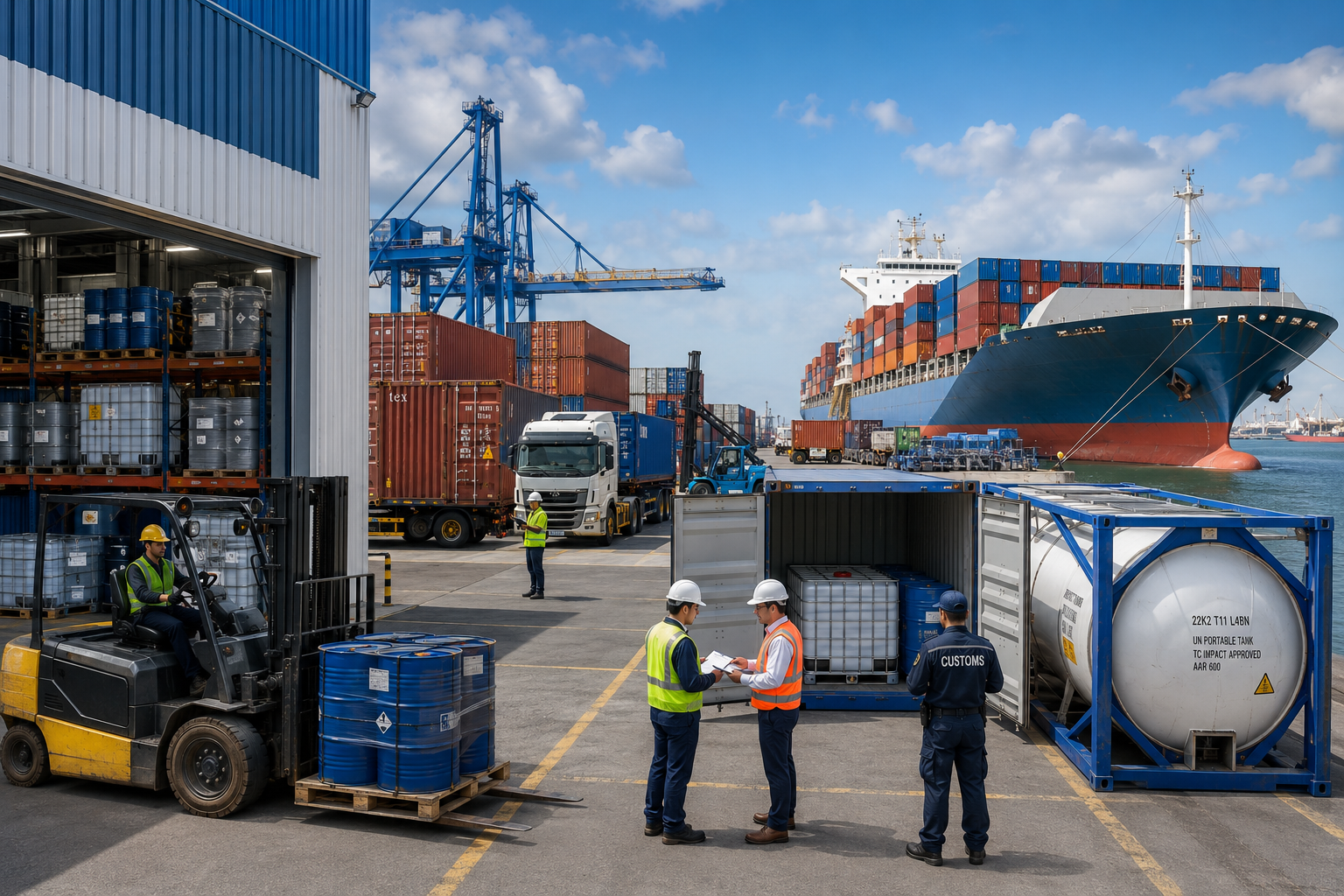
At its core, chemical import and export is the cross-border movement of raw materials, intermediates, reagents, and finished chemical products between manufacturers, distributors, and end users. It's a specialized branch of international trade because chemicals — unlike most consumer goods — carry safety, regulatory, and handling requirements that must be satisfied at every stage: manufacturing, packaging, labeling, customs clearance, transportation, and final storage.
Key Players in the Chemical Supply Chain
A typical chemical trade transaction involves several stakeholders, each with distinct responsibilities:
- Manufacturers — produce the chemical to a defined specification and grade
- Exporters/distributors — handle quality documentation, export packaging, and customs compliance
- Freight forwarders and logistics providers — manage transportation, especially for hazardous or temperature-sensitive goods
- Importers — clear customs in the destination country and ensure regulatory compliance locally
- End users — laboratories, pharmaceutical plants, food manufacturers, and industrial facilities that consume the chemical
Common Categories of Traded Chemicals
Chemical trade spans a wide range of product categories, each serving different industries:
- Acids — sulfuric, hydrochloric, nitric, and organic acids used in manufacturing and analysis
- Solvents — acetone, methanol, acetonitrile, and other AR/LR/HPLC-grade solvents
- Organic and inorganic chemicals — a broad category covering everything from basic salts to complex synthesis intermediates
- Laboratory reagents — buffers, indicators, stains, and culture media used in research and quality control
- Food-grade chemicals — additives, preservatives, and processing aids manufactured to food safety standards
- Pharmaceutical-grade chemicals — excipients and process chemicals meeting pharmacopoeial specifications
- Water treatment chemicals — coagulants, disinfectants, and testing reagents
Why Global Businesses Rely on Chemical Import and Export
No single country produces every chemical every industry needs at competitive cost and consistent quality. That's why cross-border chemical sourcing has become foundational to entire industries rather than a niche activity.
Real-world applications driving demand include:
- Pharmaceutical manufacturing — active pharmaceutical ingredient (API) intermediates and excipients sourced from specialized manufacturers to maintain consistent formulation quality
- Food and beverage processing — food-grade additives and preservatives that meet international food safety benchmarks
- Cosmetics and personal care — specialty raw materials for formulations, often sourced from regions with established chemical manufacturing infrastructure
- Agriculture — agrochemical intermediates supporting crop protection and soil treatment products
- Water treatment and municipal utilities — bulk chemicals for purification and testing, often imported to meet local demand that domestic production can't fully cover
- Industrial and laboratory research — AR/LR/HPLC-grade reagents that many countries import because local production doesn't cover the full breadth of research-grade chemistry needed
For procurement managers, the calculus usually comes down to three factors: consistent quality, competitive pricing, and reliable delivery — and finding a supplier that can deliver all three, batch after batch, is what separates a good chemical trading partner from a risky one.
Quality Standards and Certifications That Matter
When evaluating a potential chemical supplier — domestic or international — certifications aren't just paperwork. They're the clearest signal of whether a company has systems in place to deliver consistent quality.
ISO 9001:2015 and Quality Management
ISO 9001:2015 certification indicates that a manufacturer operates under a documented Quality Management System (QMS) covering everything from raw material sourcing to final dispatch. For chemical buyers, this matters because it means:
- Batch-to-batch consistency is actively monitored, not assumed
- Non-conformities have a documented corrective-action process
- The supplier undergoes periodic third-party audits to maintain certification
MSDS/SDS and GHS Classification
Every legitimate chemical shipment should be accompanied by a Material Safety Data Sheet (MSDS) or Safety Data Sheet (SDS) formatted according to the Globally Harmonized System (GHS) of classification and labeling. This document details:
- Physical and chemical properties
- Hazard classification and pictograms
- Safe handling, storage, and disposal guidance
- First-aid and emergency response information
A supplier that can't readily provide a current SDS for every product in its catalogue is a red flag, not an oversight.
Certificates of Analysis (COA)
A Certificate of Analysis confirms that a specific batch of chemical meets its stated specification — purity, appearance, and any relevant physical or chemical parameters — based on actual laboratory testing of that batch, not a generic datasheet. For regulated industries like pharmaceuticals and food manufacturing, batch-specific COAs aren't optional; they're often a prerequisite for incoming material acceptance.
Navigating International Compliance in Chemical Trade
Compliance is where most delays and costly mistakes happen in chemical import and export — usually because of incomplete documentation rather than the chemical itself being problematic.
HS Codes and Customs Classification
Every traded chemical is assigned a Harmonized System (HS) code, an internationally standardized classification used by customs authorities to determine duties, taxes, and applicable regulations. Misclassifying a product's HS code is one of the most common causes of customs delays and can result in penalties, so working with a supplier experienced in accurate HS/HSN classification for their product range meaningfully reduces shipment risk.
Export Documentation Checklist
A complete, compliant chemical export shipment typically includes:
- Certificate of Analysis (COA) — batch-specific quality confirmation
- Safety Data Sheet (SDS/MSDS) — hazard and handling information
- Packing list — itemized shipment contents and quantities
- Commercial invoice — for customs valuation
- Certificate of Origin — confirming the manufacturing country, often required for preferential tariff treatment
- UN number and hazard classification (where applicable) — for chemicals classified as dangerous goods under international transport regulations
Key Regulations to Know
Depending on the destination market, chemical shipments may need to comply with regional frameworks such as:
- REACH (Registration, Evaluation, Authorisation and Restriction of Chemicals) — the EU's chemical safety regulation
- TSCA (Toxic Substances Control Act) — the primary U.S. federal chemical regulation
- GHS — the globally harmonized hazard classification and labeling system, adopted in some form by most major trading nations
- Local customs and import licensing requirements — which vary by destination country and chemical category
An experienced export partner will already understand which of these apply to a given shipment and destination, rather than leaving the buyer to figure it out mid-transaction.
How to Choose a Reliable Chemical Import/Export Partner
With compliance and quality both riding on the supplier relationship, here's what to actually evaluate before committing:
- Certifications on file — ISO 9001:2015 at minimum, plus any industry-specific certifications relevant to your sector
- Documentation practices — can they provide COAs and SDS documents proactively, without repeated requests?
- Product breadth and consistency — a supplier with a wide, well-organized catalogue (with CAS numbers, HSN codes, and clear specifications) typically reflects more mature internal quality systems
- Packaging and logistics capability — from small lab packs to bulk industrial drums, flexibility matters for both research buyers and large-volume industrial clients
- Communication and responsiveness — international trade involves time zones, customs questions, and occasional shipment issues; a supplier that responds quickly is worth more than one that's marginally cheaper
- Track record across markets — a company already exporting successfully to multiple countries has already solved many of the compliance and logistics problems a new buyer might otherwise hit for the first time
Packaging, Storage, and Safe Handling in Chemical Logistics
Even a chemically perfect product can arrive damaged, degraded, or non-compliant if packaging and handling aren't right. Reputable exporters typically account for:
- Packaging matched to hazard classification — drums, jerry cans, or specialized containers rated for the specific chemical's hazard class
- Correct hazard labeling — GHS pictograms, UN numbers, and handling instructions clearly marked on the exterior
- Storage condition guidance — temperature, humidity, and light-sensitivity requirements communicated clearly, especially for reagents and pharmaceutical-grade materials
- Lab-pack options for small-quantity research orders — not every buyer needs a full drum, and flexible packaging reduces waste and cost for smaller laboratories
The Role of Technology in Modern Chemical Trade
Digital transformation has changed how procurement teams source chemicals internationally. Instead of relying solely on phone calls and PDF catalogues, modern buyers increasingly expect:
- Searchable online product catalogues with CAS numbers, specifications, and pack sizes readily available
- Digital inquiry and quotation systems that speed up the RFQ-to-order cycle
- Downloadable documentation — SDS, COAs, and technical datasheets available without needing to email a sales rep for basic paperwork
- Transparent certification information published openly rather than provided only on request
Suppliers that have invested in this kind of digital infrastructure generally reflect the same operational discipline in their actual manufacturing and quality processes — the two tend to go together.
Frequently Asked Questions
1. What documents are required to import chemicals internationally? At minimum, expect to need a Certificate of Analysis, Safety Data Sheet, commercial invoice, packing list, and Certificate of Origin. Chemicals classified as dangerous goods will also require UN number documentation and hazard classification paperwork.
2. How do I verify a chemical supplier's quality claims? Request their ISO certification number (verifiable with the issuing body), ask for a sample Certificate of Analysis for a product you're interested in, and confirm they can supply an SDS for every product before you commit to an order.
3. What's the difference between AR, LR, and GR grade chemicals? These are purity/quality grades common in laboratory chemicals — AR (Analytical Reagent) and GR (Guaranteed Reagent) typically indicate higher purity suited for precise analytical work, while LR (Laboratory Reagent) is generally used for less critical applications. Always check the specific purity percentage on the product's specification sheet rather than relying on the grade label alone.
4. Can small laboratories order chemicals in lab-pack quantities, or only bulk? Most established chemical suppliers offer multiple pack sizes — from small lab packs (grams to a few kilograms) up to bulk industrial drums — so laboratories and small businesses aren't forced into bulk minimums.
5. What is an HSN code, and why does it matter for import/export? HSN (Harmonized System of Nomenclature) codes are standardized product classification codes used by customs worldwide to determine duties and regulatory requirements. Incorrect HSN classification is a common cause of shipment delays, so accurate coding by the exporter matters.
6. How long does international chemical shipping typically take? Timelines vary significantly by destination, shipping method (air vs. sea), and customs processing in the destination country — ranging from a few days for air freight to regional markets, to several weeks for sea freight to more distant destinations. A supplier with export experience to your specific country can usually give a realistic estimate upfront.
7. Are there restrictions on exporting certain chemicals? Yes — many countries restrict or require special licensing for chemicals with dual-use potential, controlled precursor chemicals, or specific hazard classifications. A compliant exporter will flag these requirements during the quotation process rather than after the order is placed.
8. What should I look for in a chemical exporter's product catalogue? Look for complete specifications per product — CAS number, HSN code, purity, pack sizes, and availability of COA/SDS documentation. A catalogue that only lists product names without this detail usually signals a less mature quality system.
Conclusion
Sourcing chemicals internationally doesn't have to mean navigating compliance requirements, documentation gaps, and quality uncertainty on your own. The right chemical import and export partner brings certified quality systems, complete documentation, and export experience that removes friction from every shipment — letting your team focus on production, research, or operations instead of chasing paperwork.
If you're evaluating suppliers for laboratory reagents, fine chemicals, or specialty chemical products for your business, we'd welcome the opportunity to talk. [Contact our team] to discuss your requirements, request a quotation, or browse our full product catalogue with complete specifications, certifications, and documentation readily available.