

Chemical Storage and Handling Best Practices: A Complete Safety Guide
Chemical Storage and Handling Best Practices: A Complete Safety Guide
Improper chemical storage and handling is one of the most preventable causes of workplace incidents — and one of the most consistently under-invested-in areas of facility management. A chemical that's perfectly safe when handled correctly can become a serious hazard through incompatible storage, poor ventilation, missing labeling, or inadequate training.
This guide covers the core principles every laboratory, warehouse, and industrial facility should follow when storing and handling chemicals — from classification and storage conditions through to employee training and regulatory compliance.
Chemical Classification
Effective storage starts with understanding what you're storing. The Globally Harmonized System (GHS) classifies chemicals into hazard classes based on their physical, health, and environmental hazards:
- Flammable substances — liquids, gases, and solids that ignite easily (e.g., acetone, ethanol, hydrogen)
- Corrosives — substances that damage living tissue or materials on contact (e.g., sulfuric acid, sodium hydroxide)
- Oxidizers — substances that can intensify fire by providing oxygen (e.g., hydrogen peroxide, potassium permanganate)
- Toxic and highly toxic substances — chemicals harmful if inhaled, ingested, or absorbed through skin
- Reactive substances — chemicals that react dangerously with water, air, or other substances (e.g., some metal hydrides, peroxide-forming compounds)
- Compressed gases — stored under pressure, carrying both physical and, depending on contents, chemical hazards
Classifying every chemical in inventory correctly — and keeping that classification accessible at the point of storage — is the foundation everything else in this guide builds on. Storage decisions, PPE requirements, and emergency response procedures all depend on knowing exactly what hazard class you're dealing with.
Storage Conditions
General storage principles apply across nearly all chemical categories, though specifics vary by hazard class:
- Segregation by compatibility — never store incompatible chemicals together (e.g., oxidizers away from flammables, acids away from bases); use a compatibility chart to guide storage grouping
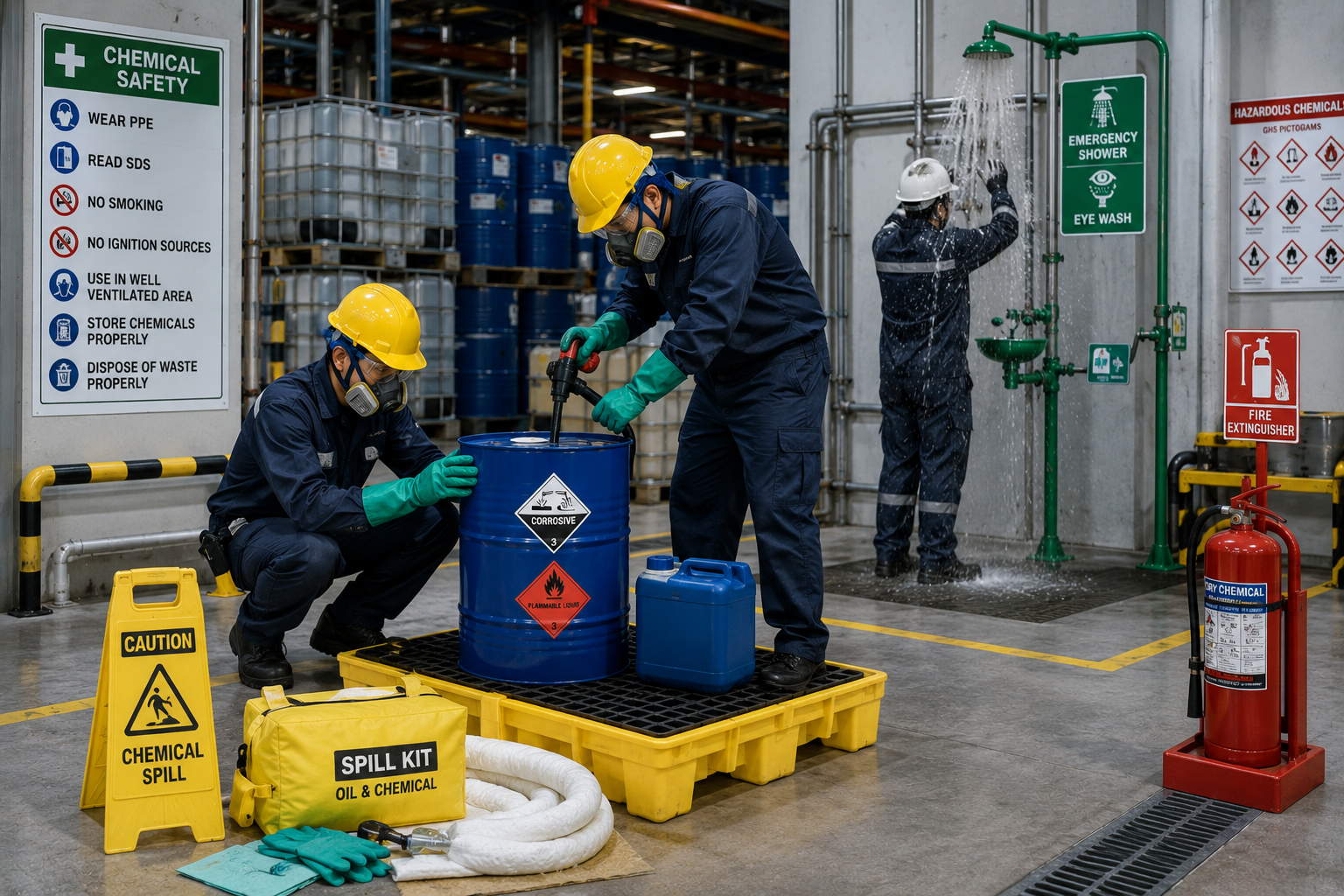
- Secondary containment — use spill trays or containment basins, especially for liquid chemicals, to contain leaks before they spread
- Adequate ventilation — prevents accumulation of hazardous vapors, particularly critical for volatile solvents and toxic substances
- Dedicated storage areas — separate from general work areas, with restricted access where hazard level warrants it
- Shelf stability — heavier containers stored on lower shelves, with secure shelving to prevent tipping
- Away from direct sunlight and heat sources — many chemicals degrade or become unstable when exposed to heat or UV light
Storage conditions should always be verified against the specific chemical's Safety Data Sheet rather than assumed from general practice, since exceptions and additional requirements are common.
Temperature Requirements
Temperature control affects both chemical stability and safety:
- Ambient storage — suitable for the majority of stable industrial chemicals, typically maintained within a defined range (often 15–25°C) to avoid degradation
- Cold storage (refrigerated) — required for temperature-sensitive reagents, certain biological materials, and chemicals prone to decomposition at room temperature
- Frozen storage — necessary for specific reagents and biological samples requiring long-term stability
- Heat-sensitive materials — some chemicals require protection from even moderate temperature elevation, which can accelerate decomposition or, in extreme cases, trigger hazardous reactions
Temperature excursions — even brief ones — can compromise both product integrity and safety for sensitive chemicals, making continuous temperature monitoring (rather than periodic spot-checks) the safer standard for critical storage areas.
Humidity Control
Moisture exposure affects chemical stability, particularly for:
- Hygroscopic chemicals — substances that absorb atmospheric moisture, potentially altering concentration, causing clumping, or triggering degradation reactions
- Moisture-reactive chemicals — some substances react hazardously with water or humidity, requiring strict humidity control and often desiccant use
- Powder and crystalline reagents — prone to caking or quality degradation in high-humidity environments
Common humidity control measures:
- Desiccant packets or active desiccant systems within storage containers and cabinets
- Climate-controlled storage rooms with monitored relative humidity
- Airtight, moisture-resistant packaging for particularly sensitive materials
- Regular humidity monitoring with documented records for regulated or quality-sensitive storage areas
Personal Protective Equipment (PPE)
PPE requirements should be matched to the specific hazards of the chemicals being handled, not applied generically:
- Gloves — material selection matters significantly; nitrile, neoprene, and butyl rubber offer different resistance profiles depending on the chemical involved
- Eye and face protection — safety goggles for splash hazards, face shields for higher-risk handling involving corrosives or reactive substances
- Respiratory protection — required when ventilation alone can't adequately control vapor or particulate exposure; respirator type must match the specific hazard (organic vapor cartridges differ from particulate filters)
- Protective clothing — chemical-resistant aprons or suits for handling corrosives or substances with significant skin-contact hazards
- Footwear — closed-toe, chemical-resistant footwear in any area where spills or splashes are a realistic risk
PPE selection should be documented and matched explicitly to each chemical's SDS recommendations — generic "one type fits all" PPE policies frequently under-protect for higher-hazard materials.
Fire Safety
Flammable and combustible chemicals require specific fire safety measures beyond general workplace fire protocols:
- Flammable liquid storage cabinets — rated and certified cabinets designed to contain and delay fire spread, keeping ignition sources separated from flammable inventory
- Ignition source control — eliminating open flames, sparks, and static discharge risks in storage and handling areas
- Proper grounding and bonding — during transfer of flammable liquids, to prevent static electricity buildup
- Fire suppression systems — appropriate to the specific hazard (e.g., Class B extinguishers for flammable liquid fires; water-reactive chemicals require specialized suppression approaches, not standard water-based systems)
- Storage quantity limits — many fire codes limit the quantity of flammable materials permitted in a given storage area without additional fire protection infrastructure
- Clear emergency egress routes — maintained and unobstructed around all chemical storage areas
Spill Management
A well-prepared spill response reduces both safety risk and environmental impact:
- Spill kits appropriate to stored chemicals — absorbents, neutralizing agents, and containment materials matched to the hazard types present
- Clear spill response procedures — documented, posted, and understood by all staff who work near chemical storage
- Containment before cleanup — preventing spread to floor drains, water sources, or adjacent storage areas is the immediate priority
- PPE for spill response — appropriate protective equipment must be donned before attempting cleanup, not improvised in the moment
- Incident reporting and documentation — spills, even minor ones, should be logged, with root cause reviewed to prevent recurrence
- Regulatory notification requirements — some spill quantities and chemical types trigger mandatory reporting to environmental or safety regulators, depending on jurisdiction
Transportation
Internal transport of chemicals within a facility carries its own risks, often overlooked relative to external shipping:
- Secure containers — chemicals should never be transported in open or unsecured containers between storage and point of use
- Compatible transport carts and equipment — designed to prevent tipping, with containment trays for liquid transport
- Segregation during transport — incompatible chemicals should not be moved together, even for short internal distances
- Trained personnel only — internal chemical transport should be limited to staff trained in safe handling procedures for the specific materials involved
- Minimum necessary quantity — transporting only what's needed for immediate use reduces exposure risk if an incident occurs en route
Warehouse Management
Effective chemical warehouse management combines safety and operational efficiency:
- Segregated storage zones — clearly defined and labeled areas for each hazard class, preventing accidental co-storage of incompatible materials
- FIFO (First In, First Out) inventory rotation — particularly important for chemicals with defined shelf lives or expiration dates
- Clear labeling and signage — every storage area and container should be identifiable at a glance, including hazard class and handling requirements
- Access control — restricting access to high-hazard storage areas to trained and authorized personnel
- Regular inventory audits — confirming stored quantities match records, checking for container integrity, and identifying expired or degraded stock
- Digital inventory tracking — increasingly standard practice, allowing real-time visibility into what's stored where, and supporting faster emergency response if needed
OSHA Principles
While specific regulations vary by country, the U.S. Occupational Safety and Health Administration's (OSHA) framework reflects widely adopted best-practice principles relevant to chemical safety globally:
- Hazard Communication Standard (HazCom) — requires employers to communicate chemical hazards through labeling, SDS availability, and employee training
- Permissible Exposure Limits (PELs) — regulatory limits on employee exposure to specific hazardous substances over defined time periods
- General Duty Clause — the broader obligation for employers to provide a workplace free from recognized hazards, even where a specific regulation doesn't explicitly address a given risk
- HAZWOPER (Hazardous Waste Operations and Emergency Response) — training standards for employees involved in hazardous waste handling or emergency response
Facilities operating outside the U.S. should consult their local equivalent regulatory framework, but the underlying principles — hazard communication, exposure limits, and a general duty of care — are broadly consistent internationally.
GHS Labeling
The Globally Harmonized System standardizes chemical hazard communication internationally, ensuring labels are understood consistently regardless of the language or country of origin. Key GHS label elements include:
- Hazard pictograms — standardized symbols (flame, corrosion, skull and crossbones, exclamation mark, and others) instantly communicating hazard type
- Signal words — "Danger" for more severe hazards, "Warning" for less severe hazards
- Hazard statements — standardized phrases describing the nature of the hazard (e.g., "Causes severe skin burns")
- Precautionary statements — guidance on prevention, response, storage, and disposal
- Product identifier and supplier information — ensuring traceability back to the manufacturer or supplier
Consistent, correctly applied GHS labeling isn't just a compliance checkbox — it's often the only information a worker has in the critical seconds after an unexpected exposure or spill.
MSDS/SDS Importance
The Safety Data Sheet (SDS) — formerly known as Material Safety Data Sheet (MSDS) — is the definitive reference document for any hazardous chemical, structured into 16 standardized sections covering:
- Identification and hazard classification
- Composition and ingredient information
- First-aid measures
- Fire-fighting measures
- Accidental release (spill) measures
- Handling and storage requirements
- Exposure controls and required PPE
- Physical and chemical properties
- Stability and reactivity information
- Toxicological information
- Regulatory and transport information
Every hazardous chemical in a facility should have a current, accessible SDS — not filed away and forgotten, but genuinely accessible to anyone handling that chemical, including in emergency situations. Facilities should maintain both physical and digital SDS access, since power outages or system failures shouldn't leave staff without critical safety information during an incident.
Employee Training
Even excellent storage systems and documentation fail without properly trained staff:
- Initial hazard communication training — covering GHS labeling, SDS use, and facility-specific storage and handling procedures for all new employees before they handle chemicals independently
- Chemical-specific training — for higher-hazard materials requiring specialized handling knowledge beyond general orientation
- PPE training — proper selection, use, and maintenance of protective equipment, not just provision of it
- Spill response and emergency drills — regular practical drills, not just documentation review, to ensure staff can respond effectively under pressure
- Refresher training — periodic retraining to reinforce procedures and cover any changes in chemical inventory or regulatory requirements
- Documentation of training completion — maintained records demonstrating compliance and supporting audit readiness
Frequently Asked Questions
1. What's the most common mistake in chemical storage? Storing incompatible chemicals together — often because staff aren't aware of specific compatibility conflicts, rather than through obvious negligence. A clear compatibility chart posted in storage areas significantly reduces this risk.
2. How often should Safety Data Sheets be reviewed or updated? SDS documents should be reviewed whenever a supplier updates their formulation or classification, and facilities should periodically confirm they're holding the most current version rather than assuming older copies remain accurate indefinitely.
3. Do all chemicals require special PPE? No, but PPE requirements should always be determined by the specific chemical's SDS rather than assumed. Some low-hazard materials require minimal protection, while others demand specialized equipment.
4. What should be included in a basic spill kit? At minimum: appropriate absorbent material for the chemicals stored, neutralizing agents if applicable, PPE (gloves, goggles), disposal bags, and clear instructions — customized to the specific hazard classes present in that storage area.
5. How long can chemicals be safely stored? This varies enormously by chemical type — some are stable indefinitely under proper conditions, while others (particularly peroxide-forming compounds and certain reactive substances) have defined shelf lives requiring disposal or retesting after a specific period. Always follow the manufacturer's guidance.
6. Is GHS labeling legally required everywhere? GHS has been adopted, in some form, by most major trading nations, though implementation timelines and specific requirements vary by country. Facilities should confirm the specific requirements applicable in their jurisdiction.
7. What's the difference between a hazard class and a hazard category? A hazard class describes the type of hazard (e.g., flammable liquid), while categories within that class indicate severity (e.g., Category 1 flammable liquids are more hazardous than Category 4). Both pieces of information are needed for correct handling decisions.
8. How often should employee chemical safety training be refreshed? Practices vary by facility and regulatory jurisdiction, but annual refresher training is a common baseline, with additional training triggered by any significant change in chemical inventory, storage procedures, or after a safety incident.
Conclusion
Chemical storage and handling safety isn't a single policy or checklist — it's a system built from correct classification, appropriate storage conditions, well-matched PPE, fire and spill preparedness, and genuinely trained employees who understand not just the rules but why they matter. Facilities that treat these as interconnected practices, rather than isolated compliance requirements, consistently see fewer incidents and faster, more effective responses when something does go wrong.
Sourcing chemicals for your facility and want guidance on storage and handling requirements specific to your products? Contact our team — every product we supply comes with complete SDS documentation, and we're glad to help you plan storage and handling procedures that match your specific chemical inventory.