

Ethanol: Properties, Applications, and Global Trade Guide for B2B Buyers
Ethanol: Properties, Applications, and Global Trade Guide for B2B Buyers
Few chemicals touch as many industries as ethanol. It's the active ingredient in hand sanitizers, a critical solvent in pharmaceutical manufacturing, a laboratory reagent used daily in research facilities, a renewable fuel additive, and one of the most widely traded industrial chemicals in the world. For procurement managers, laboratory buyers, and industrial users, understanding ethanol's properties, grades, and international trade requirements is essential to sourcing it correctly and safely.
This guide covers everything a B2B buyer needs to know about ethanol — from its chemical structure to global import/export standards — in one place.
What Is Ethanol?
Ethanol, also known as ethyl alcohol or grain alcohol, is an organic compound with the chemical formula C₂H₅OH (or C₂H₆O). It is a clear, colorless, volatile liquid with a characteristic pleasant odor and a slightly sweet, burning taste. Ethanol belongs to the alcohol family of organic compounds, distinguished by the hydroxyl (-OH) functional group attached to a two-carbon chain.
Quick identification facts:
- CAS Number: 64-17-5
- Molecular Formula: C₂H₅OH
- Molecular Weight: 46.07 g/mol
- Common names: Ethyl alcohol, grain alcohol, EtOH, alcohol
Ethanol is produced either through the fermentation of sugars by yeast (the basis of alcoholic beverages and bio-ethanol fuel) or through the catalytic hydration of ethylene (the basis of most industrial-grade ethanol). Its versatility as a solvent, disinfectant, fuel, and chemical intermediate makes it one of the highest-volume organic chemicals traded globally.
Chemical Properties of Ethanol
Ethanol's chemical behavior is defined by its hydroxyl group, which makes it both a weak acid and capable of hydrogen bonding — properties that explain much of its usefulness as a solvent.
- Reactivity: Ethanol reacts with strong oxidizing agents and can be oxidized to acetaldehyde and further to acetic acid
- Flammability: Highly flammable; forms explosive vapor-air mixtures within its flammable range
- Polarity: A polar molecule due to the hydroxyl group, allowing it to dissolve both polar (water-soluble) and moderately non-polar substances
- Miscibility: Completely miscible with water in all proportions, and miscible with most organic solvents
- Acid-base behavior: Weakly acidic; can act as both a weak acid and a weak base depending on reaction conditions
- Esterification: Reacts with carboxylic acids to form esters — a reaction widely used in flavoring and fragrance chemistry
Physical Properties of Ethanol
| Property | Value |
|---|---|
| Appearance | Clear, colorless liquid |
| Odor | Characteristic, mildly sweet |
| Boiling point | 78.37°C (173.1°F) |
| Melting point | -114.1°C (-173.4°F) |
| Density | 0.789 g/cm³ at 20°C |
| Flash point | 13°C (55.4°F) — closed cup |
| Autoignition temperature | 363°C (685°F) |
| Vapor pressure | 5.95 kPa at 20°C |
| Solubility in water | Fully miscible |
| Refractive index | 1.3611 |
These properties directly influence how ethanol must be stored, packaged, and transported — particularly its low flash point, which classifies it as a flammable liquid under international transport regulations.
Manufacturing Process
Ethanol is produced industrially through two primary methods, each suited to different end-use grades.
1. Fermentation (Bio-based Production)
This is the traditional and most common method for producing ethanol used in beverages, biofuel, and increasingly in pharmaceutical and cosmetic applications:
- Starch or sugar-based feedstocks (sugarcane, corn, molasses, wheat, or other agricultural biomass) are broken down into fermentable sugars
- Yeast (typically Saccharomyces cerevisiae) converts these sugars into ethanol and carbon dioxide through anaerobic fermentation
- The resulting fermented liquid ("wash" or "beer") typically contains 8–15% ethanol
- Distillation concentrates the ethanol to higher purity, often to 95–96% (the ethanol-water azeotrope)
- Dehydration (using molecular sieves or other techniques) can further purify ethanol to 99.5%+ for applications requiring anhydrous (water-free) ethanol
2. Catalytic Hydration of Ethylene (Petrochemical Route)
This method produces synthetic ethanol primarily for industrial and chemical applications:
- Ethylene gas (derived from petroleum or natural gas processing) reacts with steam under high pressure and temperature
- A catalyst (typically phosphoric acid on a solid support) facilitates the hydration reaction, converting ethylene to ethanol
- The resulting product is purified through distillation to achieve the required purity grade
Denaturing Process
For industrial and non-beverage applications, ethanol is often "denatured" — a small percentage of an unpalatable or toxic substance (such as methanol, isopropyl alcohol, or denatonium benzoate) is added to render it unfit for human consumption. This process allows denatured ethanol to be sold without the excise taxes applied to beverage alcohol in most countries, and is standard practice for industrial-grade ethanol supply.
Industrial Applications
Ethanol's versatility as a solvent and chemical intermediate makes it indispensable across manufacturing sectors:
- Solvent for paints, coatings, and inks — evaporates cleanly without leaving residue
- Chemical intermediate — used in producing acetic acid, ethyl acetate, and other downstream chemicals
- Fuel and fuel additive — blended with gasoline (as E10, E15, E85, etc.) to reduce emissions and extend fuel supply
- Cleaning and degreasing agent — effective at dissolving oils, resins, and residues in industrial cleaning applications
- Extraction solvent — used in extracting essential oils, flavors, and plant-based compounds
- Personal care and cosmetics manufacturing — a base solvent for perfumes, lotions, and hair care products
Pharmaceutical Applications
The pharmaceutical industry relies heavily on high-purity ethanol across multiple stages of drug development and manufacturing:
- Antiseptic and disinfectant — a core active ingredient in hand sanitizers and surface disinfectants, effective against a broad range of pathogens at concentrations of 60–90%
- Solvent for drug formulation — used in tinctures, syrups, and topical preparations to dissolve active pharmaceutical ingredients (APIs)
- Extraction solvent — used in extracting active compounds from botanical and natural sources during drug development
- Sterilization — used to disinfect equipment, surfaces, and in some sterile manufacturing processes
- Excipient — functions as a preservative and solvent carrier in various liquid pharmaceutical formulations
Pharmaceutical-grade ethanol must meet pharmacopoeial specifications (USP, EP, or BP grade, depending on the target market), with strict limits on impurities, water content, and denaturant residues.
Laboratory Applications
In research and quality-control laboratories, ethanol is one of the most frequently used reagents:
- General-purpose solvent for sample preparation, extractions, and chromatography
- HPLC-grade ethanol — used in high-performance liquid chromatography where purity directly affects analytical accuracy
- Cell culture and molecular biology — used for surface disinfection, DNA/RNA precipitation, and tissue preservation
- Histology and pathology — used in tissue fixation and dehydration processes prior to microscopy
- Reagent-grade ethanol (AR/GR) — used where high purity is critical to avoid interference with analytical results
Laboratories typically purchase ethanol in AR (Analytical Reagent), LR (Laboratory Reagent), or HPLC grades, with purity and impurity profiles documented on the Certificate of Analysis for each batch.
Safety Precautions
Because of its flammability and volatility, ethanol requires careful handling regardless of application:
- Store and handle away from open flames, sparks, and other ignition sources
- Use in well-ventilated areas to prevent vapor accumulation
- Wear appropriate personal protective equipment (PPE) — gloves and eye protection at minimum, with respiratory protection in poorly ventilated or high-concentration environments
- Avoid static electricity buildup during transfer, especially in bulk handling
- Keep away from strong oxidizing agents to prevent reactive hazards
- Ensure fire suppression equipment (rated for flammable liquid fires) is accessible wherever ethanol is stored or handled in quantity
- Consult the Safety Data Sheet (SDS) for specific first-aid, spill response, and exposure guidance before handling
Storage Guidelines
Proper storage preserves both ethanol's purity and the safety of the storage environment:
- Store in tightly sealed, corrosion-resistant containers to prevent evaporation and contamination
- Keep storage areas cool, dry, and away from direct sunlight and heat sources
- Maintain separation from oxidizers, strong acids, and other reactive chemicals
- Use grounded and bonded equipment during transfer to prevent static discharge
- Store in designated flammable-liquid storage cabinets or rooms compliant with local fire codes
- Label containers clearly with hazard classification and handling information per GHS requirements
Packaging Options
Ethanol is supplied in a range of packaging formats depending on order volume and end use:
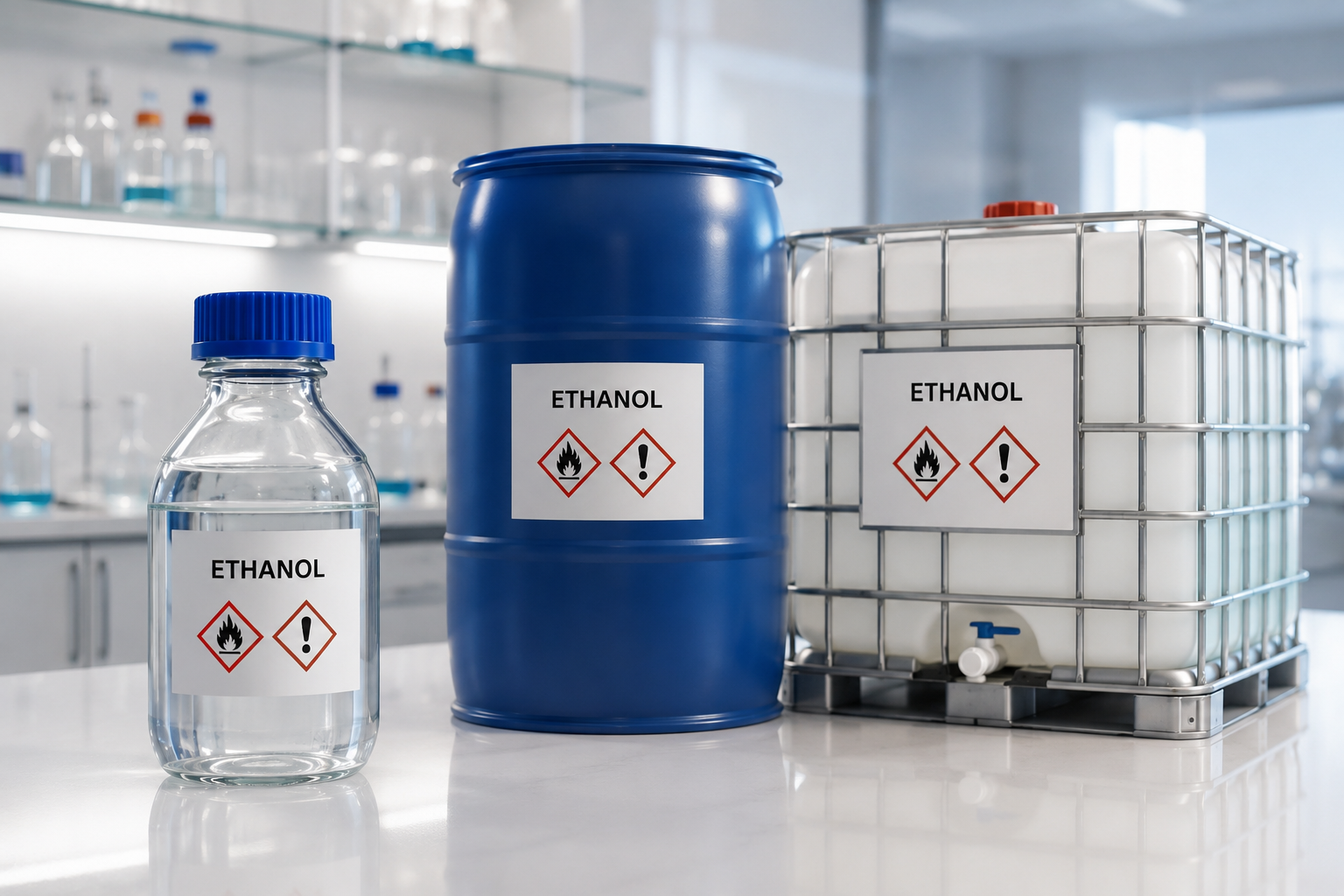
- Small laboratory packs — 500 mL to 5-liter bottles for research and QC laboratories
- Jerry cans — 25–35 liter containers for medium-volume industrial or commercial use
- Drums — 200-liter steel or HDPE drums for bulk industrial supply
- IBC totes — 1,000-liter intermediate bulk containers for large-volume industrial buyers
- ISO tank containers — for bulk international shipping of large quantities
Packaging materials must be compatible with ethanol's solvent properties and compliant with hazardous goods transport regulations for flammable liquids.
Export Standards
Exporting ethanol internationally requires compliance with several documentation and classification standards:
- HS Code classification — ethanol typically falls under HS code 2207 (undenatured ethyl alcohol) or 2207.20 (denatured ethyl alcohol), with the correct code affecting duties and import eligibility
- UN Number — ethanol is classified as UN 1170 for transport purposes, reflecting its flammable liquid hazard class
- Certificate of Analysis (COA) — confirming purity, water content, and denaturant profile (if applicable) for the specific batch
- Safety Data Sheet (SDS) — GHS-compliant documentation detailing hazards and handling requirements
- Certificate of Origin — often required for customs clearance and preferential tariff treatment
- Dangerous Goods Declaration — required for shipments classified under flammable liquid transport regulations
Import Regulations
Import requirements for ethanol vary significantly by country, largely because of its dual status as both an industrial chemical and a controlled substance in the context of alcoholic beverages:
- Many countries require import licenses or permits specifically for ethanol, distinct from general chemical import licensing, due to excise and taxation considerations
- Denatured ethanol often faces different (typically lower) duty rates than undenatured ethanol, which can be diverted to beverage use
- Some jurisdictions require proof of denaturant composition to qualify for industrial-use duty rates
- Import quotas or additional documentation may apply in countries with domestic ethanol production industries (particularly biofuel-producing nations)
- Buyers should confirm specific import licensing requirements with local customs authorities before finalizing international ethanol purchase agreements
Global Demand for Ethanol
Global ethanol demand has grown substantially over the past two decades, driven by three converging trends: expanding biofuel mandates, sustained pharmaceutical and hygiene product demand (accelerated further by increased sanitization standards), and steady industrial solvent consumption. Fuel-grade ethanol accounts for the largest share of global production volume, while pharmaceutical, laboratory, and industrial-grade ethanol represent smaller but higher-value, quality-sensitive market segments where buyers prioritize purity and consistent documentation over price alone.
Major Importing Countries
Countries with significant ethanol import demand include:
- United States — despite being a major producer, imports specific grades for regional supply balancing
- European Union nations — importing both fuel-grade and industrial-grade ethanol to supplement domestic production
- India — a large importer of ethanol for industrial, pharmaceutical, and increasingly fuel-blending purposes
- Philippines — significant importer for fuel-blending programs
- South Korea — imports industrial and denatured ethanol for manufacturing applications
- Nigeria and other African markets — growing import demand for industrial and pharmaceutical-grade ethanol
Major Exporting Countries
Leading ethanol-exporting nations include:
- Brazil — one of the world's largest ethanol producers, primarily from sugarcane, with substantial export volumes
- United States — a major global exporter despite high domestic consumption, particularly of fuel-grade ethanol
- European Union — exports industrial and specialty-grade ethanol, particularly from grain-based production
- India — an increasingly significant exporter of industrial and pharmaceutical-grade ethanol alongside its import activity in other grades
- Pakistan — a notable exporter of molasses-based industrial ethanol to regional and international markets
Market Trends
Several trends are shaping the global ethanol market heading into the coming years:
- Biofuel policy expansion — government mandates for ethanol blending in gasoline continue to expand in multiple regions, driving sustained demand growth
- Sustainability and bio-based sourcing — increasing buyer preference for ethanol produced from renewable, agricultural feedstocks over petrochemical routes
- Pharmaceutical-grade demand growth — sustained demand for high-purity ethanol in sanitizers, disinfectants, and pharmaceutical manufacturing following heightened global hygiene standards
- Supply chain diversification — buyers increasingly sourcing from multiple countries and suppliers to reduce dependency risk following recent global supply chain disruptions
- Rising quality documentation expectations — B2B buyers increasingly expect readily available COAs, SDS documents, and traceability information as standard practice, not a special request
Frequently Asked Questions
1. What is the difference between denatured and undenatured ethanol? Undenatured ethanol is pure ethyl alcohol suitable for beverage or pharmaceutical use without restriction. Denatured ethanol has additives making it unsuitable for consumption, allowing it to be sold for industrial use at lower tax rates in most jurisdictions.
2. Is ethanol the same as isopropyl alcohol (IPA)? No. Ethanol (C₂H₅OH) and isopropyl alcohol (C₃H₈O) are different alcohols with distinct chemical structures, though both are used as solvents and disinfectants. They are not interchangeable in all applications.
3. What purity grade of ethanol is needed for hand sanitizer production? Regulatory guidance generally requires ethanol concentrations of 60–90% in the final sanitizer formulation, using pharmaceutical or food-grade ethanol as the starting material, along with denaturants as required by local regulations.
4. What is HPLC-grade ethanol used for? HPLC-grade ethanol is a high-purity grade specifically manufactured with minimal UV-absorbing impurities, making it suitable for high-performance liquid chromatography and other sensitive analytical applications where trace contaminants would interfere with results.
5. How should ethanol be transported internationally? Ethanol must be transported in compliance with dangerous goods regulations (as UN 1170, flammable liquid), with correct packaging, labeling, and documentation including an SDS and Dangerous Goods Declaration for the shipment.
6. Why do ethanol import duties vary so much between countries? Duty rates often depend on whether the ethanol is denatured (industrial use) or undenatured (potential beverage use), as well as each country's domestic ethanol production policy and any applicable biofuel or agricultural trade agreements.
7. Can ethanol be stored long-term without degrading? Yes, when stored properly in sealed containers away from heat, light, and contamination sources, ethanol has a long shelf life. However, containers should remain tightly sealed, as ethanol is hygroscopic and can absorb atmospheric moisture over time, altering its concentration.
8. What documentation should I request when buying ethanol internationally? At minimum, request a Certificate of Analysis for the specific batch, an SDS, and confirmation of the applicable HS code and denaturant status, particularly if you're sourcing across international borders.
Conclusion
Ethanol's role spans nearly every major industry — from pharmaceutical manufacturing and laboratory research to industrial solvents and renewable fuel. Its widespread use also means sourcing it correctly requires attention to purity grade, denaturant status, safety compliance, and the documentation that international trade in flammable, regulated chemicals demands.
Whether you need pharmaceutical-grade ethanol for formulation work, HPLC-grade ethanol for your laboratory, or bulk industrial ethanol for manufacturing, working with a supplier who provides complete documentation — Certificates of Analysis, Safety Data Sheets, and correct export classification — removes the guesswork from your supply chain.
Looking for a reliable ethanol supplier for your business? Contact our team to discuss your purity requirements, pack sizes, and export destination — we're ready to provide the documentation and consistent quality your operations depend on.